How to decorate around a wall mounted TV so it looks built in sounds like it should be about finding the right decor pieces, but that’s rarely the real problem.
More often, it’s the large black rectangle that keeps drawing the eye, making the wall feel disconnected from the rest of the room.
A few framed prints get added, a plant is tucked into the corner, and a decorative basket finds its place underneath.
Even after all that, the wall can still feel unfinished, with the television standing out more than everything around it.
The issue isn’t a lack of decor, it’s that the TV still feels like a separate object instead of part of the room.
The goal isn’t to make the TV disappear. It’s to make it feel like it has always belonged there.
That often comes down to creating balance, paying attention to spacing, choosing pieces that work together, and letting the television become part of the overall design instead of competing with it.
Once the wall feels intentional instead of simply decorated, the television stops looking like an afterthought.
It becomes part of the room’s architecture, and the whole space feels calmer, more cohesive, and far more inviting.
Why Most Wall Mounted TVs Never Actually Look Built In

Before getting into what to add, it helps to know what’s actually going wrong.
Most TV walls fall short for one of three reasons, and none of them are about missing decor.
- The TV was treated as an afterthought. Decor got added around it after the fact instead of designed with it in mind, so everything reads as separate pieces instead of one composition.
- There’s no visual anchor. Without shelving, molding, or a defined frame around the screen, the eye has nothing to tell it “this is where the design starts and ends.”
- The spacing is uneven. Items are placed to fill gaps rather than to create rhythm, so the wall feels busy instead of balanced.
Once you can spot which of these is happening on your own wall, the fix gets a lot more obvious.
This is really the heart of how to decorate around a wall mounted TV: giving the screen a role in the design instead of treating it like an obstacle.
Fixing that starts in a place most people never think to look, which is the wall itself.
Frame the TV With Shelving So It Looks Built In

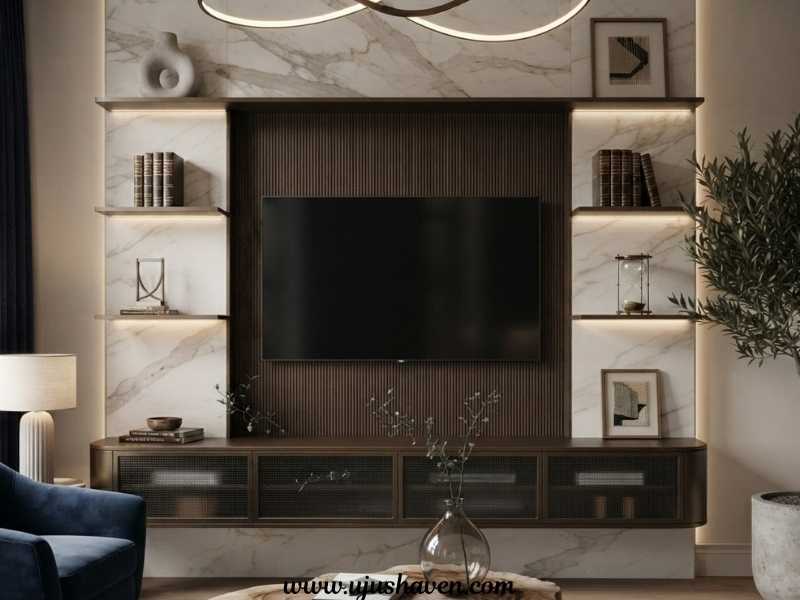
The single biggest shift that makes a wall mounted TV look built in is giving it an actual frame, the way a fireplace or a window would have one.
Floating shelves on either side of the screen do this instantly.
So does simple wall molding, a painted accent panel behind the TV, or even a wood backing that extends slightly past the edges of the screen.
The point is to create a visual boundary so the television reads as the centerpiece of a designed feature, not a device stuck on drywall.
A quiet reality worth knowing here: the frame doesn’t need to touch the TV to work.
Even shelving mounted a few inches away on either side creates enough structure for the eye to connect it all as one unit.
That’s really the whole idea behind how to decorate around a wall mounted TV, giving it boundaries so it reads as architecture instead of an appliance.
Practical tip: Keep shelf brackets thin and in a finish that matches your TV’s bezel (usually black or dark bronze) so the shelves feel like they were built for this wall, not added on top of it.
Use Symmetry to Style Around Your Wall Mounted TV

Symmetry is doing more work in “built-in” looking TV walls than almost anything else.
It’s the difference between a wall that looks curated and one that looks like things were placed wherever there was room.
This doesn’t mean matching everything exactly.
It means balancing visual weight on both sides of the screen:
- If you place a tall plant on one side, balance it with a stack of books or a sculptural object of similar height on the other.
- If one shelf holds three small items, the opposite shelf should hold a similar number, not one lonely object.
- Keep colors distributed evenly rather than clustering all the warm tones on one side and the neutrals on the other.
This is the same principle that makes How to Style a Console Table Behind a Sofa So It Actually Looks Intentional work so well below a TV setup too, since a console positioned centered under the screen gives the whole wall a natural anchor point to balance around.
One thing worth remembering: symmetry doesn’t have to mean identical.
Two objects with similar visual weight but different shapes (a round vase across from a stack of square books) often look more intentional than two of the exact same item, since it reads as a choice rather than a matched set from a store.
Style the Console Table Below Your Mounted TV

If there’s furniture beneath your mounted TV, it’s doing more visual work than people usually give it credit for.
A console table, media stand, or low dresser centered under the screen grounds the whole arrangement and keeps the TV from feeling like it’s floating in space with nothing supporting it.
When styling this piece, resist the urge to fill every inch. A cleaner approach usually works better:
- One larger object (a lamp, a sculptural vase, or a stack of books) on one side
- One smaller grouping on the other, kept low so it doesn’t compete with the screen
- A single tray in the center to visually “hold” smaller items together, which also makes the surface far easier to keep looking tidy day to day
Rectangular Decorative Tray Styling Secrets That Make Any Corner Feel Intentional goes deeper into this exact technique if you want the styling to feel more considered than “candle, remote, done.”
A detail that’s easy to miss until you see it in person: keep everything on the console shorter than the TV’s lower edge.
The moment an object rises above that line, it starts competing with the screen instead of supporting it.
Paint the Wall Behind Your TV to Match the Screen
This is the one people overlook the most, and it’s often the one that makes the biggest visual difference.
A bright white or pale wall makes a black TV screen stand out sharply, no matter what’s arranged around it.
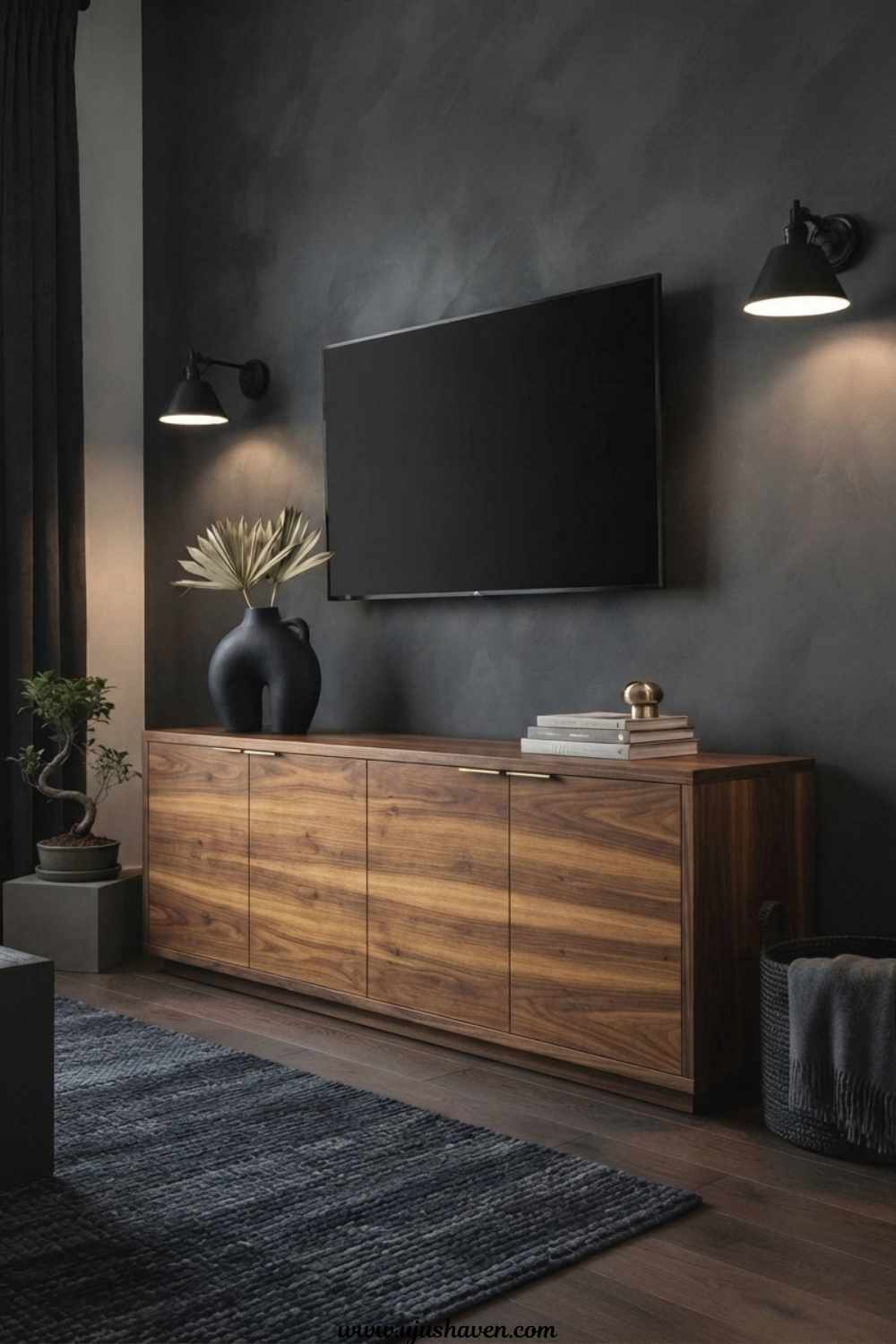
A deeper wall color, painted directly behind and slightly beyond the TV, softens that contrast so the screen blends into the background instead of interrupting it.
You don’t need to repaint the whole room for this.
An accent wall or even just the section behind the television, in charcoal, deep navy, or a warm espresso tone, is usually enough.
When the screen is off, it should almost disappear into the wall rather than sit on top of it like a sticker.
It’s also one of the few parts of how to decorate around a wall mounted TV that costs almost nothing, since it changes how the whole wall reads before any styling even happens.
Renting, or not ready to commit to paint? Peel-and-stick paneling or a large framed piece of dark fabric mounted behind the TV creates almost the same blending effect, and both come down just as easily as they went up.
Add Texture Around the TV to Soften the Screen
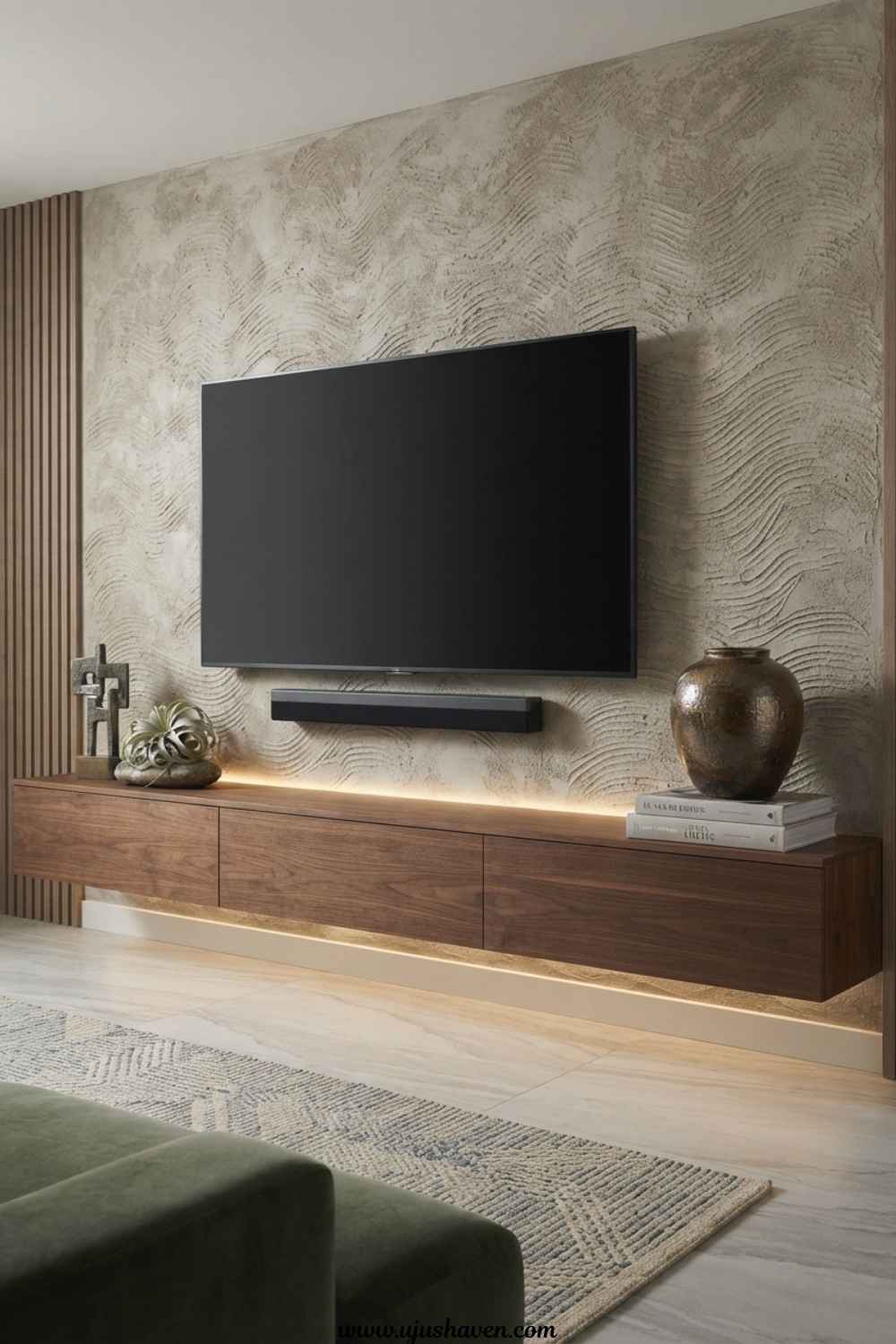
A mounted TV is flat, glossy, and rectangular.
Everything else on the wall should work to soften that, not repeat it.
This is where texture becomes more useful than more decor.
- Woven baskets, ceramic vases, or ridged pottery break up the smoothness of the screen
- A leafy plant with organic, irregular shapes contrasts nicely against the TV’s hard lines
- Layered textiles, like a woven runner on the console, add warmth that a screen simply can’t
The goal isn’t to hide the television.
It’s to surround it with enough visual softness that it stops being the only thing your eye notices in the room.
One thing that’s easy to overlook: matte finishes read as noticeably softer than glossy ones next to a screen, so a matte ceramic vase does more of this work than a glass one ever will.
Leave Negative Space Around Your TV Wall

It’s tempting to fill every open space once you start styling, but negative space is what makes a wall mounted TV setup look designed rather than decorated.
Crowded shelves and busy consoles pull attention away from the TV in the wrong way, they just make the whole wall feel cluttered instead of balanced.
A good rule of thumb: after styling, step back and see if your eye can rest somewhere.
If every inch is filled, pull back by about a third.
Empty space around objects is what makes them look chosen rather than crammed in.
If the wall your TV is mounted on also shares a corner that’s never quite felt used, it’s worth solving both at once. How to Decorate an Empty Corner in a Living Room That Actually Gets Used covers how to bring that space into the same visual plan instead of treating it separately.
Helpful Tips for How to Decorate Around a Wall Mounted TV
A few things that tend to come up only after you’ve actually started the project:
- Mount height matters more than decor. A TV mounted too high throws off the balance of everything around it, no amount of styling fixes that. Eye level while seated is the target.
- Hide the cords before you style anything else. A cord-management kit or in-wall channel takes twenty minutes and instantly makes the whole setup look more finished, before a single decorative item goes up.
- Don’t match the frame color to the wall exactly. A slight contrast (even a shade or two darker) helps the “frame” around the TV actually read as intentional instead of blending away entirely.
- Real plants photograph and age better than faux ones in this spot, since they catch light differently than a flat screen and keep the area feeling alive.
- If your overall aesthetic leans toward warm, classic, unfussy pieces, Old Money Living Room Ideas That Don’t Cost a Fortune pairs naturally with this kind of built-in styling, since that look also relies heavily on framing, symmetry, and restraint rather than clutter.
Frequently Asked Questions
What is the best height to mount a TV so it looks built in?
Center the screen at eye level while seated, typically 42 to 48 inches from the floor to the center of the screen in most living rooms.
Mounting too high is the most common reason a TV never blends into the wall.
Should I paint the wall behind a mounted TV a dark color?
Yes, in most cases. A darker wall color behind the screen reduces the contrast between the black bezel and the wall, which makes the TV noticeably less prominent when it’s off.
How do I hide TV wires for a cleaner built-in look?
An in-wall cord kit is the cleanest option and doesn’t require an electrician for a standard setup.
A cord cover channel painted to match the wall is a simpler no-drill alternative that still hides the cable run.
What size shelves work best around a wall mounted TV?
Shelves that extend slightly beyond the width of the TV on each side, rather than shelves that are noticeably shorter or taller than the screen, keep the whole arrangement looking proportional.
Final Thoughts
Learning how to decorate around a wall mounted TV was never really about finding the right accessories. It’s about giving the screen a role in the room instead of treating it as something to work around.
Frame it, balance it, soften it with texture, and leave enough breathing room for the eye to rest, and the television stops looking like equipment mounted on drywall. It starts looking like it was always meant to be there.