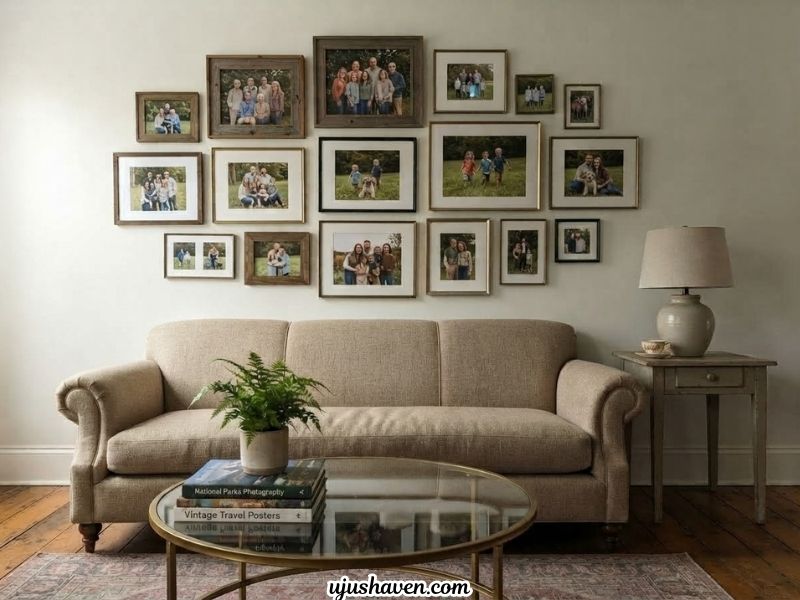
How to display family photos without looking cluttered can become surprisingly frustrating when you’re standing in front of a wall with a frame in your hand, moving it a few inches to the left, then wondering if another frame beside it will make things better or worse.
Maybe you’ve already tried matching frames, moved photos from the mantel to a shelf, then from the shelf to the hallway, or searched through countless gallery wall examples hoping one arrangement would finally make sense in your space. Still, something feels off.
At some point, it’s easy to decide that the problem is simply having too many family photos, or that other people just have a better eye for decorating.
But the number of memories isn’t necessarily what’s making the space feel crowded.
Sometimes, the problem comes from the way certain pieces are competing with everything around them.
You don’t need to become a stylist, buy a whole new set of frames, or hide the photos you love.
What matters is learning how to work with what you already have so it feels intentional, balanced, and still personal.
The first step is understanding what is actually creating that cluttered feeling.
The Secret to Making Family Photos Look Intentional

Most of the time, clutter doesn’t come from having too many family photos. It comes from visual competition.
When several elements are all trying to get your attention at once, your eye doesn’t know where to land.
That’s the actual feeling behind “cluttered.” Not too many memories. Too much competing for the same space.
A few things quietly create that competition:
- Too many different frame styles sitting next to each other
- Spacing that changes from one photo to the next with no real pattern
- Photos scattered across several unrelated surfaces in the same room
- Treating every photo like it deserves equal attention
- Mixing bright, busy photographs with equally busy decor
- Adding more photos simply because there’s more space left to fill
That’s really the core of how to display family photos without looking cluttered: the number was never the real problem. The competition was.
Give the photos a visual system before giving them more space.
Everything from here builds on that one sentence.
Start by Choosing the Photos You Actually Want to See
Before you touch a frame or measure a wall, it helps to slow down and actually look at what you have.
This is the part most articles skip, probably because it feels less exciting than arranging things.
But it’s where the real shift happens.
You might have eighty photos on your phone, in old albums, or saved in a folder somewhere.
You don’t need all eighty on your living room wall. You might only need eight.
Ask yourself a few honest questions as you go through them:
- Which photos still make me stop and smile when I see them?
- Which ones naturally belong together?
- Are there several nearly identical shots from the same day or event?
- Do I need every school photo, every vacation shot, and every family portrait in this one room?
- Would some of these be better kept in an album instead of on display?
Here’s a small trick that helps more than people expect: the photos you scroll past quickly on your phone are usually the same ones that get overlooked on a wall too.
If a photo doesn’t grab you the moment you see it now, it’s unlikely to be the one anyone stops in front of later.
Editing your photos isn’t the same as getting rid of memories.
You’re deciding what earns wall space right now, and what stays safely stored for later.
Choose One Main Display Area in the Room
One of the biggest reasons a photo collection feels cluttered isn’t the number of photos.
It’s how many places they’re spread across within a single room.
If you have photos on the mantel, more beside the TV, a few on the console, and another cluster on a nearby shelf, your eye never gets a break.
Every surface is competing for attention at the same time.
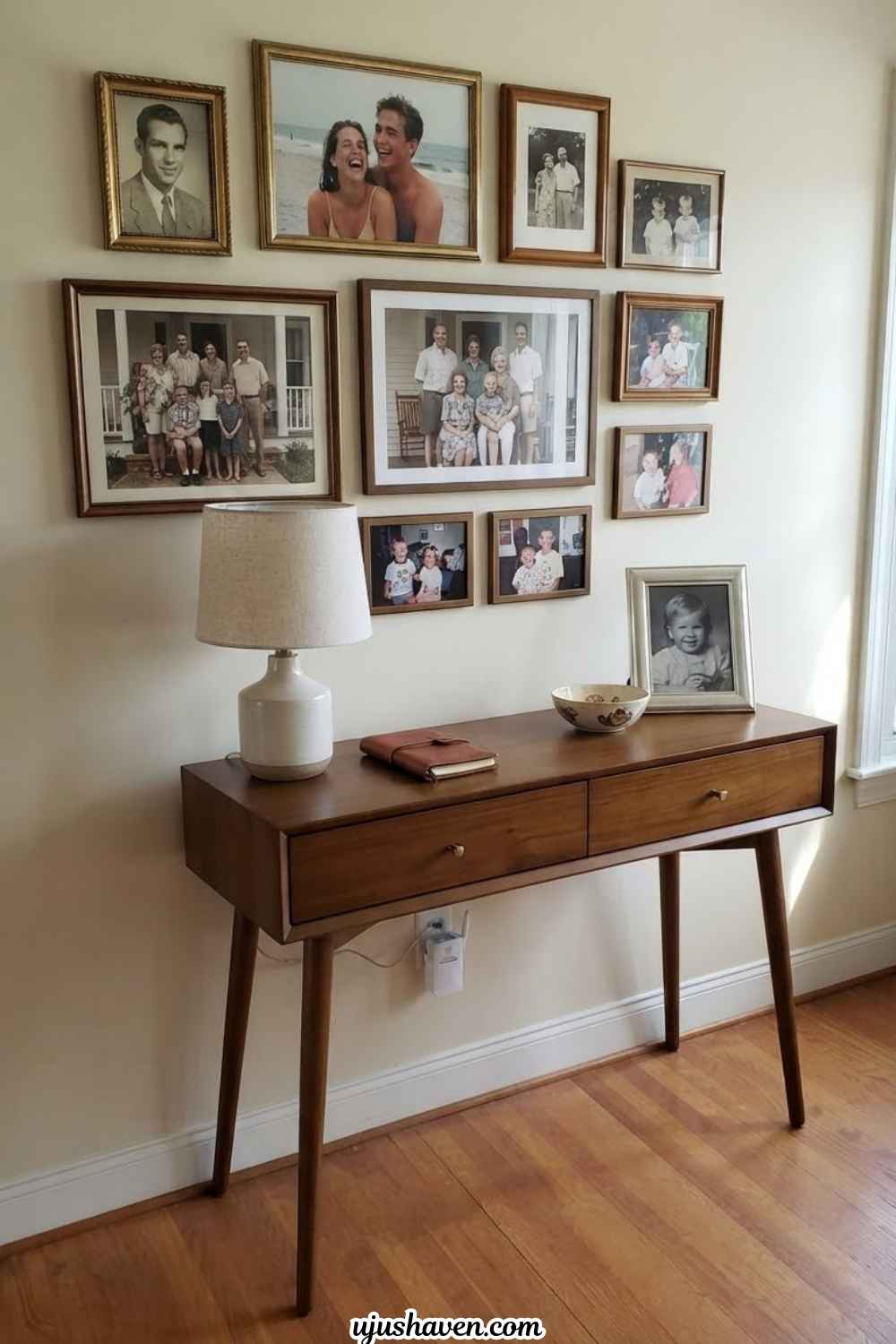
Instead, pick one main area in that room to hold most of your collection.
This could be:
- One wall
- The space above a console table
- A staircase wall
- A corner that isn’t being used for much else
If you already have a hard time using an awkward space in your living room, this can double as your family photo spot. How to Decorate an Empty Corner in a Living Room That Actually Gets Used.
This is really the simplest shift in how to display family photos without looking cluttered, because it removes the competition before you’ve picked a single frame.
This doesn’t mean the rest of your home has to be photo-free.
It means each room should have one clear focal point for its photos, rather than several small displays pulling attention in different directions.
A bedroom, a hallway, or a home office can have its own smaller collection.
The goal is one strong area per room, not one area for the whole house.
Decide How the Photos Should Relate to One Another
Once you’ve picked your photos and your main area, the next decision is simple: do you want the collection to feel structured, relaxed, or easy to change?
A structured feel means the photos follow a consistent grid, spacing, or frame style.
It reads as calm and polished, and works well when you’re displaying several photos together at once.
A relaxed feel means the frames aren’t identical, but there’s still a clear relationship between them, maybe a shared color, a similar spacing rhythm, or sizes that echo each other without matching exactly.
This suits homes that feel collected over time.
An easy to change feel usually means leaning photos on a shelf or ledge instead of hanging each one.
This works well if you like swapping photos often, or you’d rather avoid a wall full of nail holes.
None of these is better than the others.
They’re just different starting points, and deciding early saves you from second-guessing every frame placement later.
Let the Frames Do Some of the Organizing

Here’s a question worth asking early: what if the photos themselves are completely different from each other in color, subject, and mood?
That’s where frames step in.
They can create consistency even when your photographs don’t match at all.
- Different photos with similar frames usually look cohesive.
- Similar photos with completely different frames can start to feel busy.
- Different photos, different frames, different sizes, and different colors all at once is the hardest combination to control.
Pick one common thread and stick to it.
That could be the same frame color, the same material, a similar finish, consistent matting, or one main frame style with a few intentional variations.
Matching every single frame isn’t automatically the answer, though.
A perfectly identical gallery can look beautiful, but it can also feel stiff, closer to a showroom than a home.
The goal is connection between the pieces, not forced uniformity.
Give Each Photo Enough Breathing Room
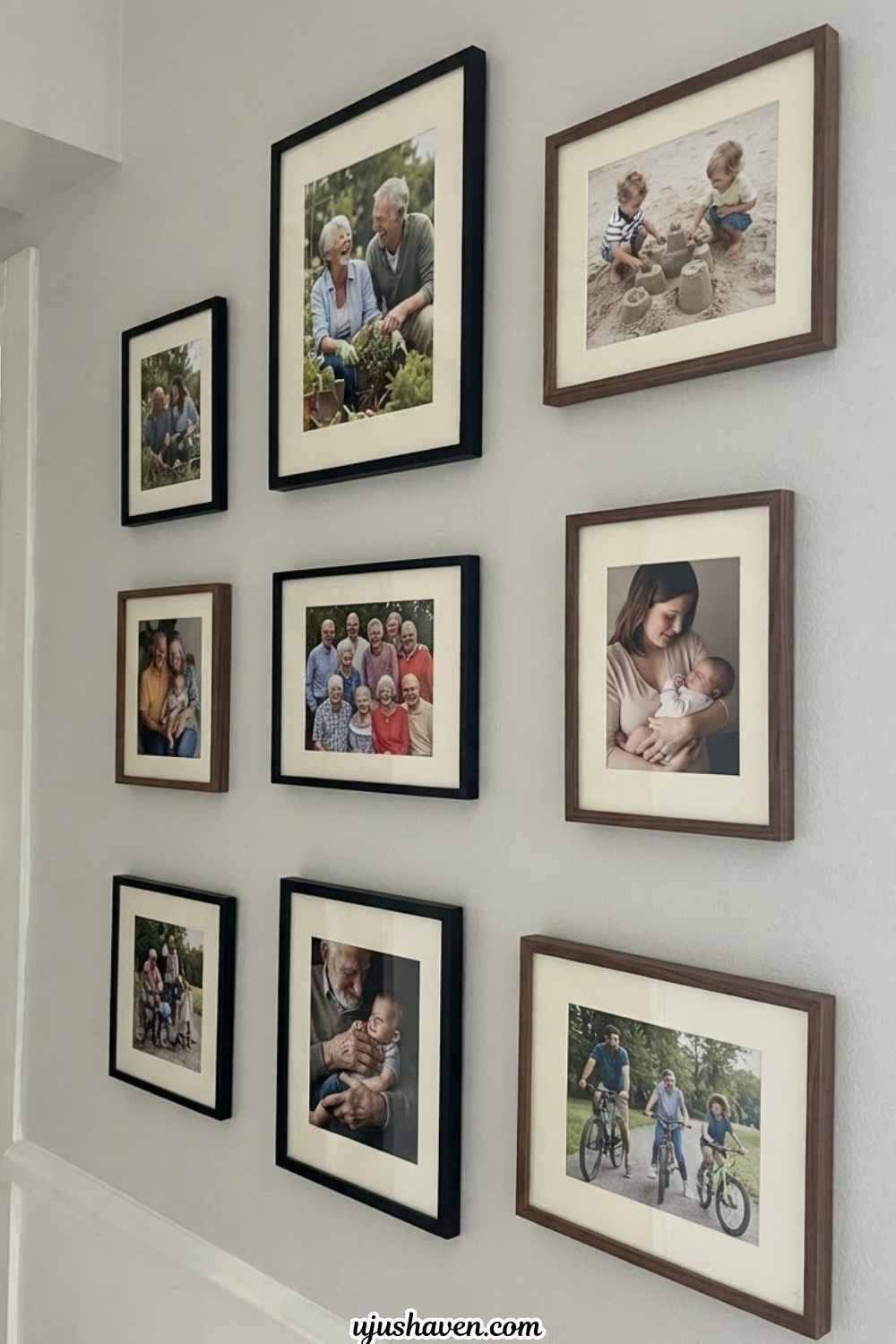
Often, the issue isn’t too many photos. It’s not enough space between them.
You don’t need a tape measure or a strict formula here, but there is a simple way to check yourself.
Frames shouldn’t sit so close that they start to visually merge into one block.
And the spacing between them should look deliberate, the same rough gap repeated on purpose, rather than accidentally different from one frame to the next.
A few practical checks:
- Leave a small, consistent gap between frames instead of pushing them edge to edge.
- Leave some empty wall space around the whole collection, not just between individual pieces.
- Avoid crowding photos right up against nearby decor, like a lamp or a vase.
- On a shelf or console, let a little bit of surface stay empty on purpose.
If your eye can’t tell where one photograph ends and the next one begins, that’s usually the clearest sign the arrangement needs more room.
What to Do When Your Family Photos Are All Different Sizes
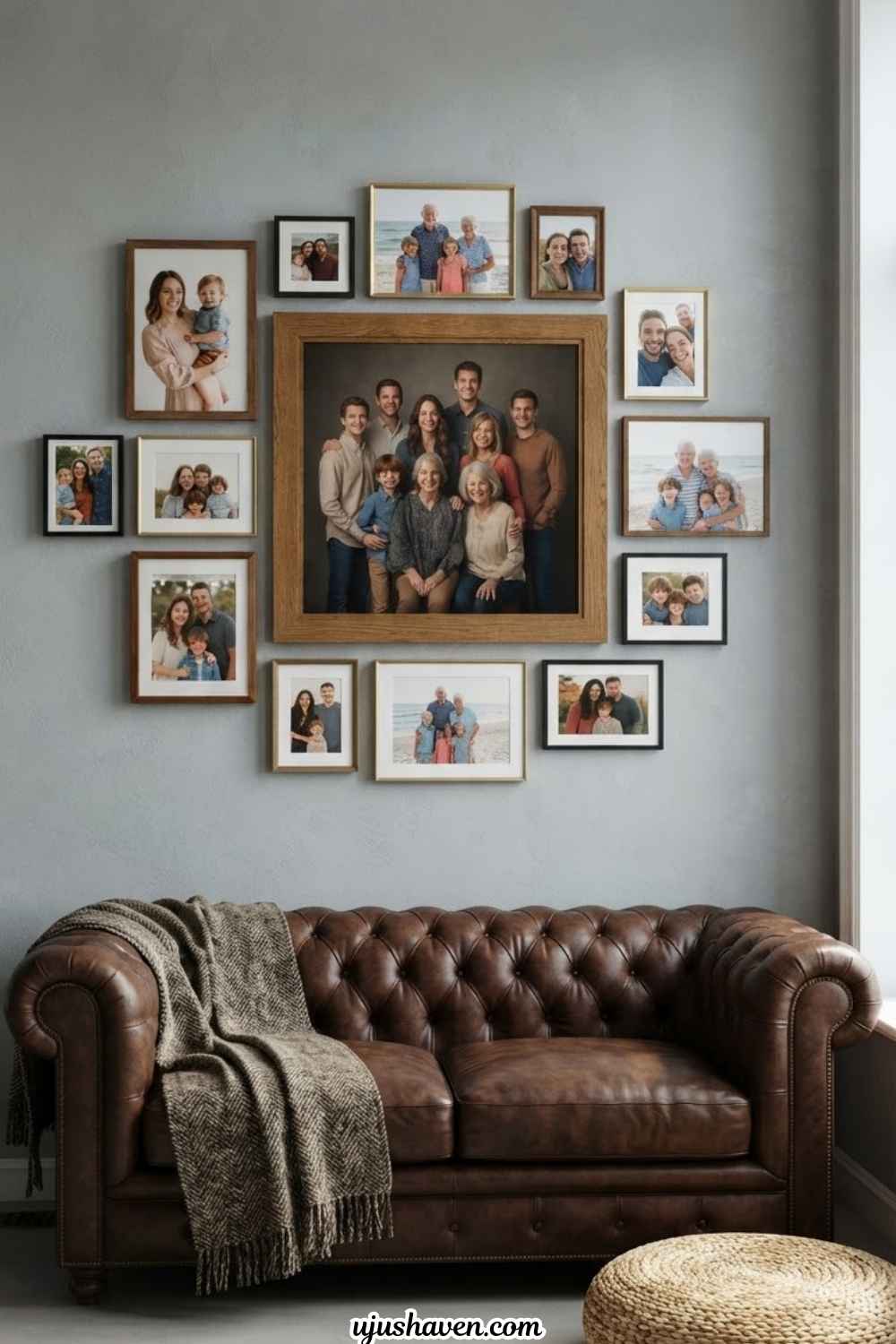
This is a very real, very common problem.
You might be dealing with one large wedding photo, a few 5×7 family portraits, an older black-and-white photo, and school pictures in odd, mismatched sizes.
The advice to “just use matching frames” doesn’t really solve this. What helps is creating hierarchy.
Pick one or two photos to act as visual anchors.
An anchor is usually the largest photo in the group, or the one that carries the most emotional weight for you, a wedding portrait, a milestone family photo, something your eye naturally goes to first.
Everything else supports that anchor instead of competing with it.
A few ways to build that hierarchy:
- Let the anchor sit at the center or highest point of the arrangement.
- Group smaller photos together instead of spacing them evenly with the larger ones.
- Use mats to make smaller photos feel more substantial next to bigger frames.
- Avoid scattering every size randomly across the space.
Once there’s a clear anchor, the smaller photos stop looking like leftovers and start looking like they belong.
Keep the Rest of the Room Quiet Around the Photos
Even a well-arranged photo display can look cluttered if it’s competing with everything else nearby: busy wallpaper, a crowded console, patterned curtains close by, or too many other decorative objects in the same sightline.
Sometimes the fix isn’t touching the photos at all. It’s simplifying what surrounds them.
This shows up a lot with console tables that are already carrying lamps, candles, books, and baskets.
How to Style a Console Table Behind a Sofa So It Actually Looks Intentional Adding one more frame to a surface that’s already full is often what tips the whole area over.
The same idea applies near a large mirror.
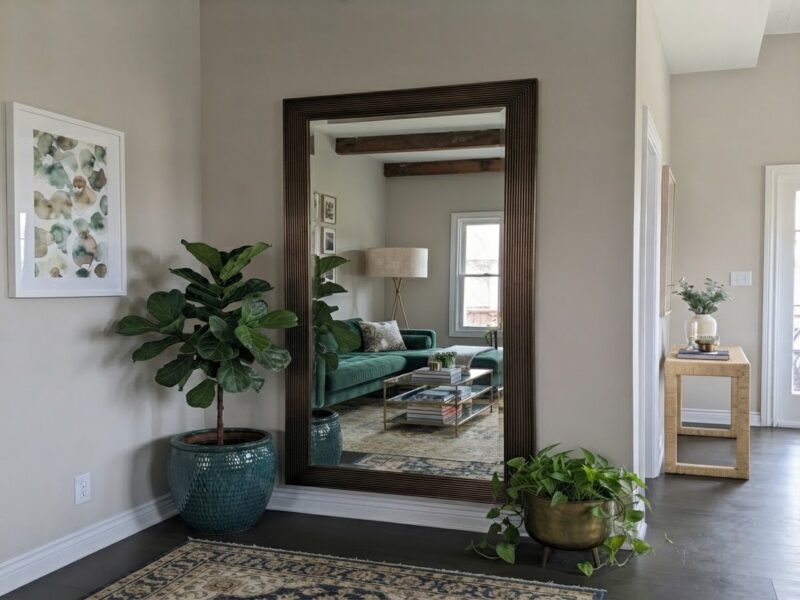
A mirror already surrounded by too many accessories can pull attention away from your photos instead of framing them well. How to Decorate Around a Large Mirror Without Overcrowding the Wall
When a Family Photo Display Still Feels Too Busy
Maybe you’ve done all of this and it still doesn’t feel right.
If you’ve been searching for how to display family photos without looking cluttered and still feel stuck, this is usually where the answer shows up.
Work through this list in order:
- Are there too many photos in the display?
- Is there enough space between each one?
- Are the frames competing with each other?
- Are the photos competing with the decor around them?
- Is there a clear focal point?
- Are there too many separate photo areas in the same room?
The answer usually sits somewhere in the first three or four.
Once you find it, the fix is often smaller than expected, a little more spacing, one less frame, or moving a nearby object out of the way.
You Don’t Have to Display Every Meaningful Photograph
There’s a quiet pressure that comes with family photos, the feeling that if a photo matters, it has to be on the wall.
But sentimental value doesn’t automatically mean a photograph needs to be on display.
A few other ways to keep meaningful photos close without adding to the display:
- A photo album you can flip through whenever you want
- A rotating digital frame
- Swapping a few photos out seasonally
- A smaller, more personal collection kept in a bedroom
- Storing certain photos safely until you’re ready to display them
This isn’t about minimalism for its own sake.
It’s about letting your home hold some quiet space while your memories stay just as close.
A Simple Way to Know When You’re Done
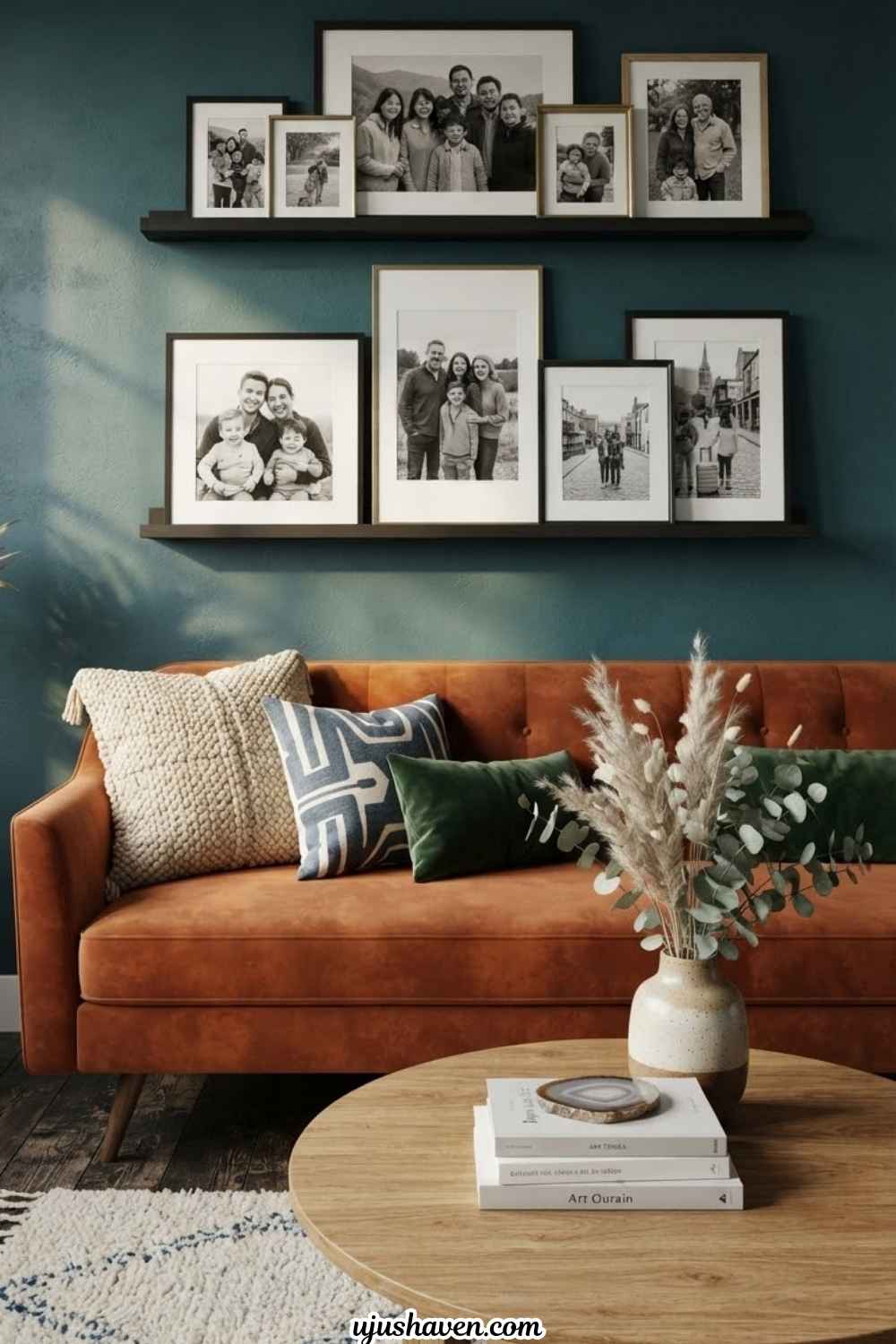
It’s easy to keep tweaking a photo display forever.
Step back and ask yourself:
- Can I clearly notice each individual photo?
- Does my eye have somewhere to rest?
- Is there one clear focal point?
- Do the frames feel connected to each other?
- Does this feel like my home, not a showroom?
One more thing worth doing before you call it finished: give it a few days.
A display that feels like a lot on day one often settles the moment you stop noticing it every time you walk past, which is usually the real sign it’s working.
If adding one more photo makes you wonder whether you should move something else, you’re probably already done.
Frequently Asked Questions About Displaying Family Photos
How many family photos should I display together?
There isn’t a fixed number that works for every space. What matters more is the size of your wall or surface, the size of your photos, the spacing between them, and what else is nearby.
Should all family photo frames match?
Not necessarily. Matching frames can create a calm, polished look, but a coordinated mix, frames that share a color or material without being identical, often feels warmer and more personal.
How do you display family photos without looking cluttered?
Edit your collection first, group similar photos together, give them enough space, and choose one main display area instead of spreading them around the room.
Should family photos be in every room?
They can be, as long as each room has one clear focal point rather than several small, competing displays.
How do you mix old and new family photos together?
Frames, matting, and thoughtful grouping help older and newer photos sit together naturally. The goal isn’t making everything look the same, it’s letting the differences become part of the story.
Final Thoughts
None of this is really about frames or wall space.
It’s about deciding which memories deserve to be seen clearly, and giving them room to actually stand out instead of blending into everything around them.
A photo wall doesn’t need to look professionally styled to work.
It just needs to feel like it belongs to the people living in that home, memories you chose on purpose, arranged with a little care, and left with enough space to breathe.